
Identity and Access Architecture
Imported content for Identity and Access Architecture.
Identity and Access Architecture
Executive Summary
The bondingAI Platform uses WorkOS exclusively for authentication and authorization. This document addresses concerns about external traffic and demonstrates why this architecture is the optimal choice for enterprise deployments.
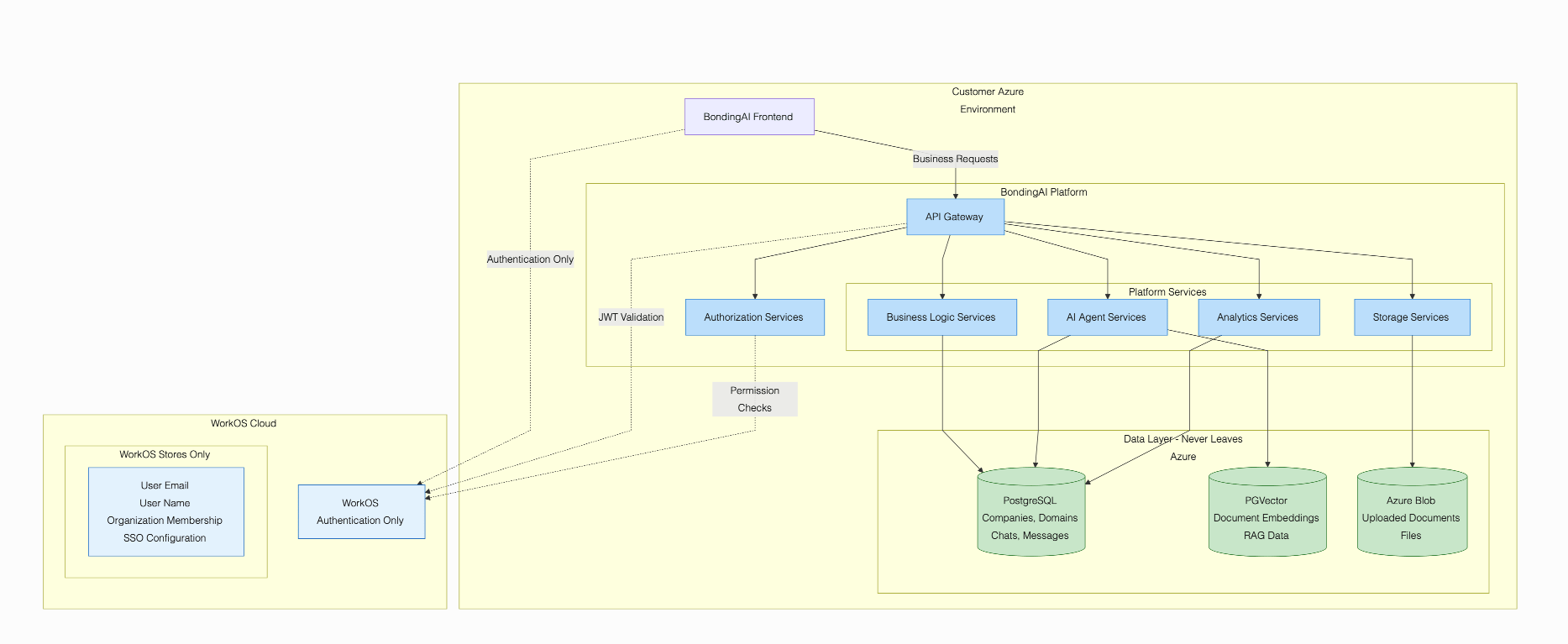
Key Point: WorkOS handles only identity verification. Zero business data (chats, documents, AI responses, analytics) leaves the customer's cloud environment.
Architecture Overview
Data Flow Separation
The following diagram illustrates the clear boundary between business data (which remains entirely within the customer's Azure environment) and authentication data (handled by WorkOS).
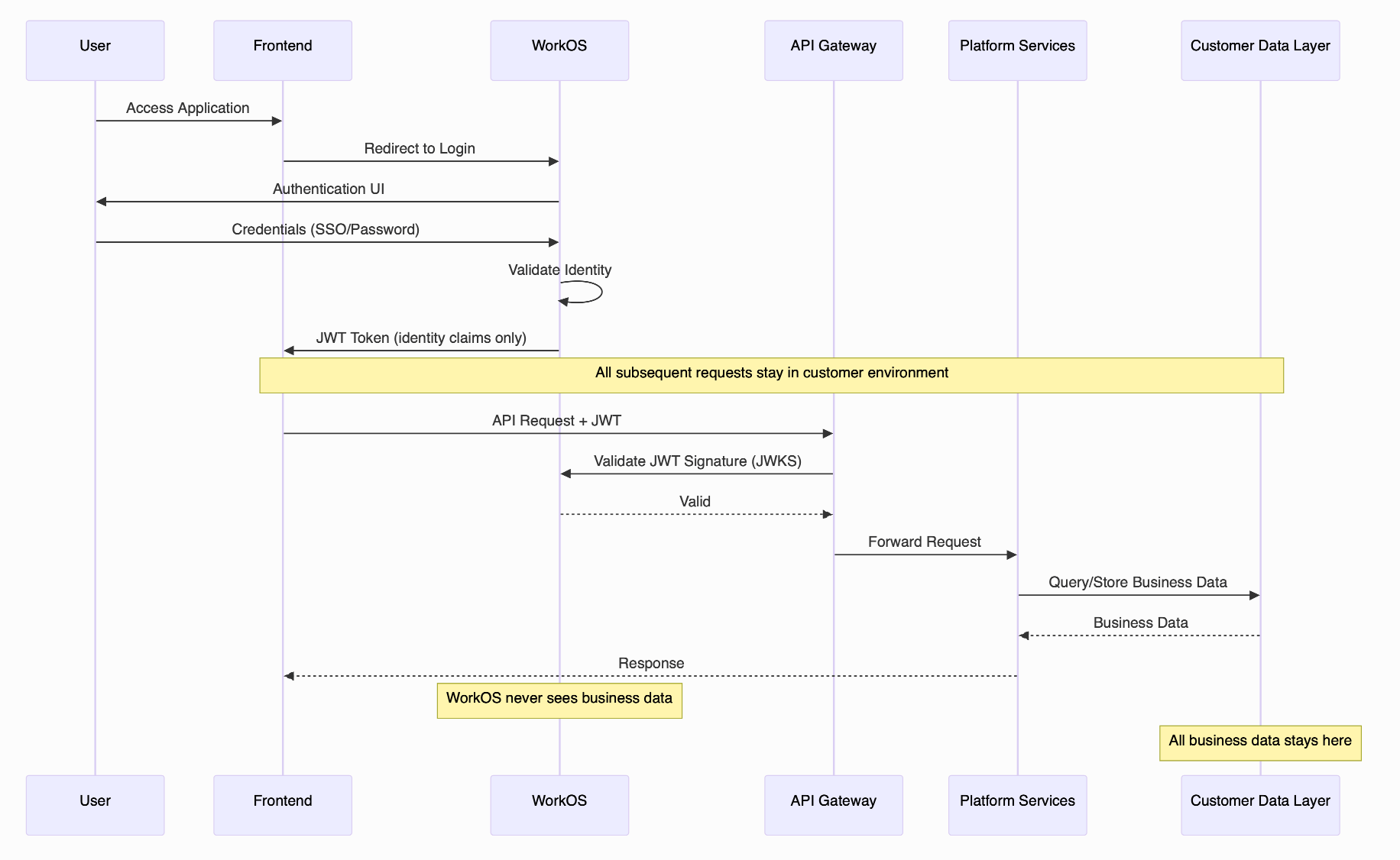
Authentication Flow
Data Classification
| Data Category | Examples | Storage Location | Leaves Customer Cloud |
|---|---|---|---|
| Chat Content | Messages, AI responses, conversation history | Customer PostgreSQL | No |
| Documents | Uploaded files, PDFs, knowledge base | Customer Azure Blob | No |
| Embeddings | Vector representations, RAG data | Customer PGVector | No |
| Analytics | Usage metrics, KPIs, dashboards | Customer PostgreSQL | No |
| Company Data | Organizations, domains, configurations | Customer PostgreSQL | No |
| User Identity | Email, name, organization membership | WorkOS | Yes (auth only) |
| SSO Config | SAML/OIDC provider settings | WorkOS | Yes (auth only) |
| Access Tokens | JWT tokens for session management | WorkOS | Yes (auth only) |
WorkOS Security and Compliance
WorkOS maintains enterprise-grade security certifications and compliance standards:
| Certification | Status | Description |
|---|---|---|
| SOC 2 Type 2 | Certified | Annual audit of security controls, availability, and confidentiality |
| GDPR | Compliant | European data protection regulation compliance |
| CCPA | Compliant | California Consumer Privacy Act compliance |
| HIPAA | BAA Available | Business Associate Agreement available for healthcare customers |
| PCI DSS | Certified | Payment Card Industry Data Security Standard |
Security Practices:
- Annual third-party penetration testing
- External code audits
- Encrypted data at rest and in transit (TLS 1.3)
- Trust Center with publicly available compliance documentation
- Data Processing Addendum (DPA) available
WorkOS processes only the data sent from identity providers during authentication. No business application data is transmitted to or stored by WorkOS.
Why Not Alternative Solutions
Cost Impact
Replacing WorkOS with alternative solutions such as Microsoft Entra External ID, Auth0, or a custom-built authentication system would result in drastically increased costs for the customer:
| Cost Category | With WorkOS | With Alternative |
|---|---|---|
| Implementation Timeline | Ready to go | ~ 2-3 months |
| Custom Admin Portal | Included | Must build |
| Directory Sync (SCIM) | Included | Additional licensing or custom development |
| Ongoing Maintenance | Included | Customer responsibility |
Feature Gap
Removing WorkOS means losing access to enterprise-ready features that would need to be rebuilt:
- Admin Portal: Built-in self-service portal for customer IT administrators to configure SSO and directory sync without vendor support
- Directory Sync: Automatic user provisioning/deprovisioning from Azure AD, Okta, Google Workspace
- Multi-IdP Support: Simplified integration with multiple identity providers per organization
- Fine-Grained Authorization (FGA): Resource-level permission management
Development Burden
| Capability | WorkOS | Custom/Alternative |
|---|---|---|
| SSO Configuration UI | Built-in Admin Portal | Must design and build |
| SCIM Implementation | Turnkey | Must implement SCIM server |
| Multi-tenant Organizations | Native support | Must architect |
| Enterprise SSO (SAML/OIDC) | Pre-built connectors | Must build each integration |
Risk Analysis
Risks of Replacing WorkOS
| Risk | Impact | Mitigation Effort |
|---|---|---|
| Extended development timeline | 2-3x longer implementation | Significant |
| Custom admin portal required | High development cost | High |
| Maintenance burden shifts to customer | Ongoing operational cost | Permanent |
| Loss of enterprise B2B features | Reduced competitiveness | Requires custom development |
| Security responsibility transfer | Customer must maintain auth security | Continuous |
Why External Authentication Traffic is Acceptable
The separation of authentication from business data is a recognized architectural best practice adopted by leading technology companies:
Industry Adoption:
- Vercel, Netlify, Webflow use WorkOS for authentication
- OpenAI and Slack separate authentication traffic from business data
- Plaid and other fintech companies follow this pattern
Technical Rationale:
- Authentication tokens contain only identity claims (who the user is)
- Business data (what the user does) never traverses external networks
- JWT validation uses public JWKS endpoints (cryptographic verification, no data exposure)
- TLS 1.3 encryption protects all authentication traffic
Compliance Alignment:
- SOC 2, GDPR, and HIPAA frameworks recognize the distinction between identity data and business data
- Authentication-as-a-Service is an accepted pattern for regulated industries
Summary
The bondingAI Platform architecture maintains a clear separation between:
| Concern | Handled By | Location |
|---|---|---|
| Identity (who is the user) | WorkOS | External (secure) |
| Business Data (what the user does) | Customer Azure | Internal (customer-controlled) |
Benefits of Current Architecture:
- Data Sovereignty: All business data remains within the customer's Azure environment
- Enterprise Security: SOC 2 Type 2, GDPR, HIPAA-ready authentication infrastructure
- Reduced Complexity: Pre-built enterprise features eliminate custom development
- Cost Efficiency: Included features would cost significantly more to build and maintain
- Industry Standard: Architecture pattern validated by leading B2B SaaS companies
Replacing WorkOS would increase implementation costs, extend timelines, and shift ongoing security and maintenance responsibilities to the customer without improving data privacy, as business data already remains entirely within the customer's environment.