Architecture and Governance
Imported content for Architecture and Governance.
Architecture and Governance
bondingAI AIOS is designed as an enterprise AI platform that helps organizations move from isolated AI experiments to governed, reusable, and measurable AI products. This view is intentionally business-oriented: it explains how the platform creates value, how teams operate on top of it, and how governance and trust are enforced across all capabilities.
Platform Architecture at a Glance
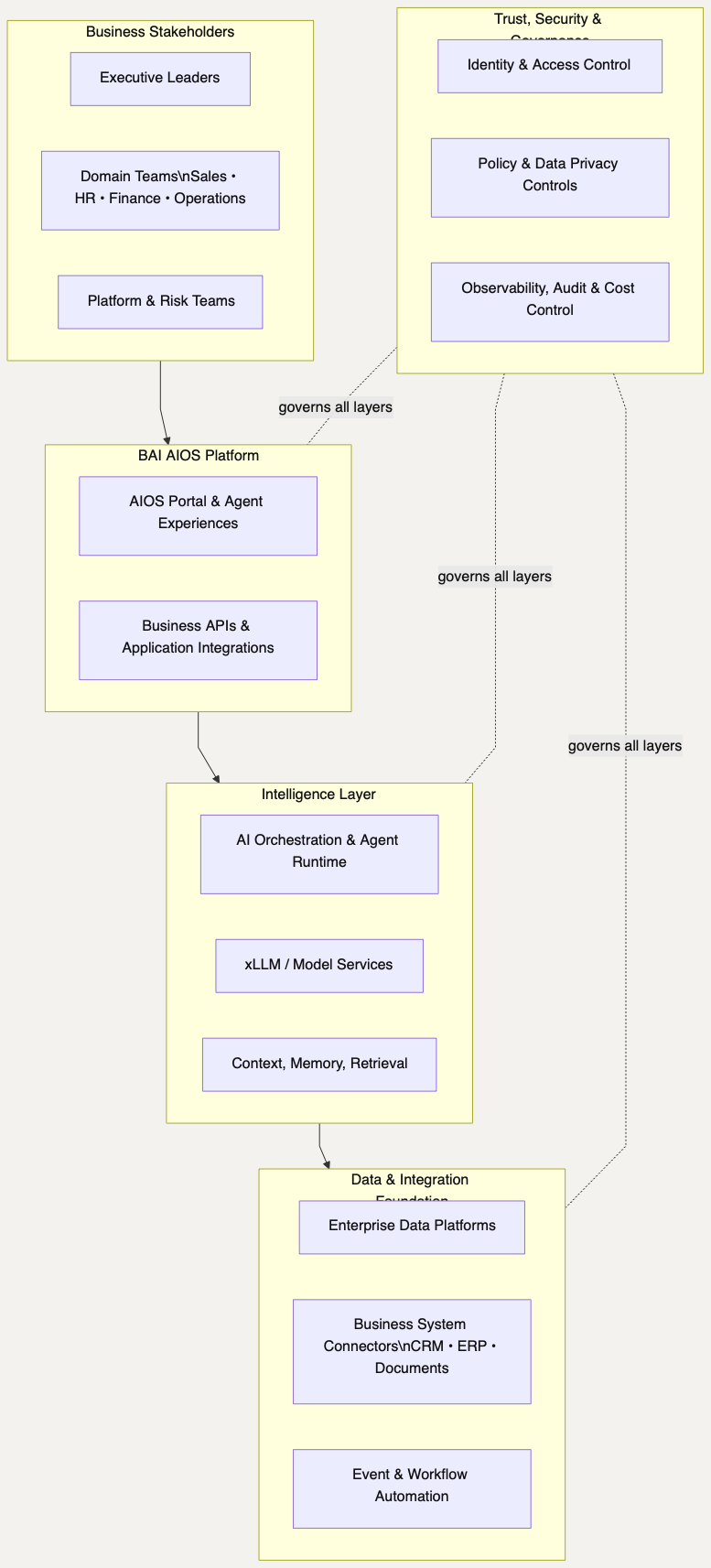
Platform Objects
| PLATFORM OBJECT | BUSINESS MEANING | TYPICAL OWNER |
|---|---|---|
| Organization | Enterprise boundary for governance, identity, and standards | CIO / Platform Leadership |
| Domain | A business area with clear data and outcome ownership | Domain Leaders |
| AI Product / Agent | Reusable AI capability with defined KPIs and lifecycle | Product Owner + Domain Team |
| Workspace / Collaboration Surface | Where teams build, monitor, and improve AI solutions | Delivery Teams |
| Governance Policies | Rules for access, privacy, compliance, and operational controls | Security / Risk / Platform Ops |
Capability Layers and Business Outcomes
| CAPABILITY LAYER | BUSINESS OUTCOME | PLATFORM ARTIFACTS |
|---|---|---|
| Experience Layer | Faster adoption and decision support for business users | Portal UX, APIs, embedded AI experiences |
| Intelligence Layer | Reliable AI execution across use cases | Agent runtime, model orchestration, retrieval/context services |
| Data & Integration Foundation | Trusted data activation across enterprise systems | Data platform integration, connectors, workflows |
| Trust, Security & Governance | Safe scale with auditability and policy enforcement | Identity provider integration, access control, observability, policy engine |
Business Value Flow

This operating loop helps teams treat AI as a managed business product instead of a one-time project.
Trust and Control Overlay
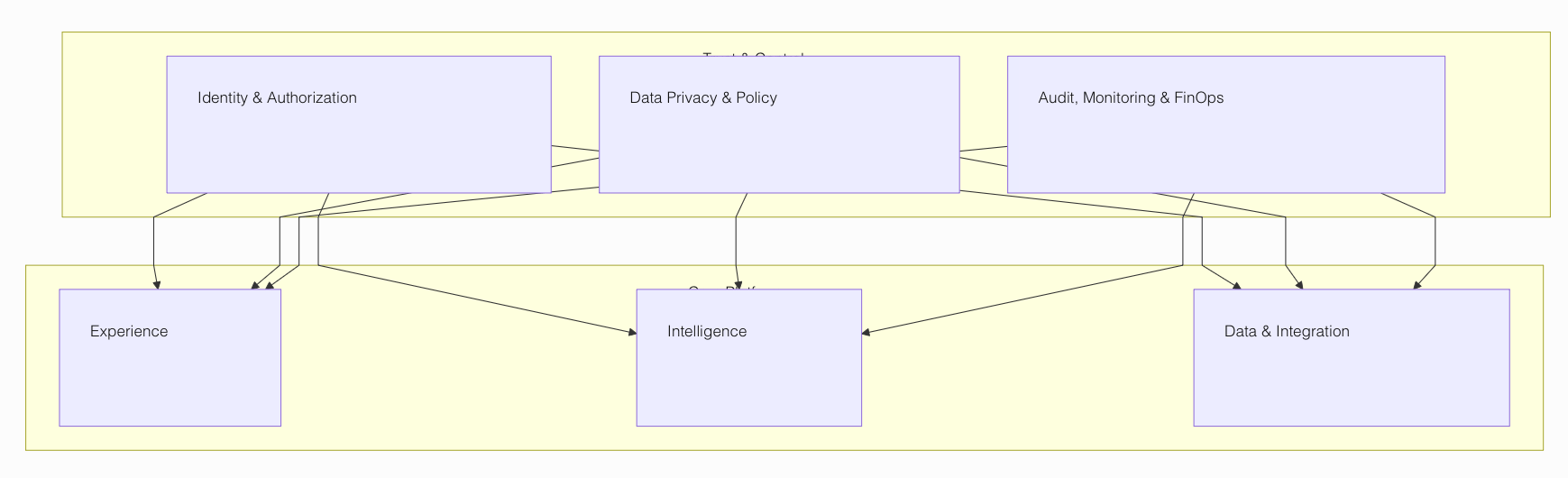 For deeper observability and governance details, see AI Governance.
For identity and authorization boundary decisions, see Identity and Access Architecture (WorkOS).
For deeper observability and governance details, see AI Governance.
For identity and authorization boundary decisions, see Identity and Access Architecture (WorkOS).
Reliability and SLA Model
Market-standard architecture documentation usually keeps SLA details in a dedicated operational page while summarizing reliability intent in architecture. bondingAI follows that pattern:
- Architecture defines where reliability controls exist (identity, policy, observability, fail-safe operations).
- SLA documentation defines how reliability is measured and committed (targets, monitoring model, accountability). See SLA reference:
| Service Type | Response Time | Estimated Resolution Time |
|---|---|---|
| Critical incidents (system unavailable) | up to 2 business hours | up to 8 business hours |
| Medium incidents (partial failures or slowness) | up to 4 business hours | up to 24 business hours |
| General requests (functional support, adjustments, questions) | up to 1 business day | according to complexity |